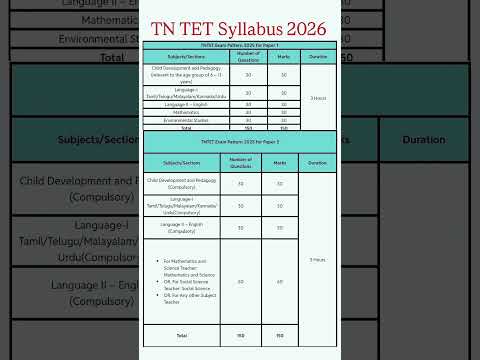
| Child Development & PedagogyChild Development & Pedagogy | Concept of development & relationship with learning; Principles of child development; Influence of heredity & environment; Socialisation; Theories of Piaget, Kohlberg, Vygotsky; Concept of intelligence; Multi-dimensional intelligence; Language & thought; Gender as a social construct; Individual differences; Inclusive education; Assessment for learning.Concept of development & relationship with learning; Principles of child development; Influence of heredity & environment; Socialisation; Theories of Piaget, Kohlberg, Vygotsky; Concept of intelligence; Multi-dimensional intelligence; Language & thought; Gender as a social construct; Individual differences; Inclusive education; Assessment for learning. |
| Language I — ComprehensionLanguage I — Comprehension | Two unseen passages — one prose & one poem — followed by linguistic comprehension, language and grammar based questions. Pedagogy of language development — learning & acquisition, principles of language teaching, role of listening & speaking, oral & written communication, teaching-learning materials, evaluation.Two unseen passages — one prose & one poem — followed by linguistic comprehension, language and grammar based questions. Pedagogy of language development — learning & acquisition, principles of language teaching, role of listening & speaking, oral & written communication, teaching-learning materials, evaluation. |
| Language II — ComprehensionLanguage II — Comprehension | Two unseen passages from a different language than Language I — comprehension, grammar & verbal ability. Pedagogy of language development — same outline as Language I.Two unseen passages from a different language than Language I — comprehension, grammar & verbal ability. Pedagogy of language development — same outline as Language I. |
| MathematicsMathematics | Number system; Addition, subtraction, multiplication, division; Geometry — shapes & spatial understanding; Solids around us; Measurement; Weight; Time; Volume; Data handling; Patterns; Money. Pedagogy of mathematics — nature of math, place of math in curriculum, language of math, community math, evaluation, problems of teaching, error analysis.Number system; Addition, subtraction, multiplication, division; Geometry — shapes & spatial understanding; Solids around us; Measurement; Weight; Time; Volume; Data handling; Patterns; Money. Pedagogy of mathematics — nature of math, place of math in curriculum, language of math, community math, evaluation, problems of teaching, error analysis. |
| Environmental Studies (Paper I) / Social Studies (Paper II)Environmental Studies (Paper I) / Social Studies (Paper II) | Family & friends; Food; Shelter; Water; Travel; Things we make and do; History (Paper II); Geography (Paper II); Social & political life; EVS pedagogy — concept and scope, environmental studies & education, learning principles, scope & relation to science and social science, approaches of presenting concepts, activities, experimentation, CCE.Family & friends; Food; Shelter; Water; Travel; Things we make and do; History (Paper II); Geography (Paper II); Social & political life; EVS pedagogy — concept and scope, environmental studies & education, learning principles, scope & relation to science and social science, approaches of presenting concepts, activities, experimentation, CCE. |