| General Aptitude (15 marks, common)General Aptitude (15 marks, common) | Verbal aptitude — basic English grammar, vocabulary, reading comprehension; Quantitative aptitude — data interpretation, numerical computation, mensuration, ratios; Analytical aptitude — logic, deduction, analogy; Spatial aptitude.Verbal aptitude — basic English grammar, vocabulary, reading comprehension; Quantitative aptitude — data interpretation, numerical computation, mensuration, ratios; Analytical aptitude — logic, deduction, analogy; Spatial aptitude. |
| Engineering Mathematics (common to most papers)Engineering Mathematics (common to most papers) | Linear algebra; Calculus; Differential equations; Complex variables; Probability & statistics; Numerical methods; Transform theory.Linear algebra; Calculus; Differential equations; Complex variables; Probability & statistics; Numerical methods; Transform theory. |
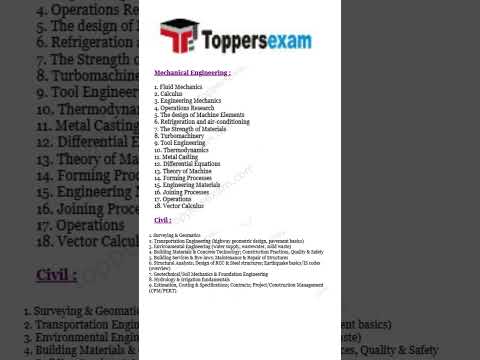
| Core Subject (CS / EE / ME / CE / EC / CH / IN / etc.)Core Subject (CS / EE / ME / CE / EC / CH / IN / etc.) | Branch-specific BTech-level syllabus. For CS — Digital Logic, Computer Organisation, Programming & Data Structures, Algorithms, Theory of Computation, Compiler Design, Operating Systems, Databases, Computer Networks. For ME — Mechanics, Strength of Materials, Theory of Machines, Vibrations, Thermodynamics, Fluid Mechanics, Heat Transfer, Manufacturing, Industrial Engineering. Other branches mirror their BTech curricula.Branch-specific BTech-level syllabus. For CS — Digital Logic, Computer Organisation, Programming & Data Structures, Algorithms, Theory of Computation, Compiler Design, Operating Systems, Databases, Computer Networks. For ME — Mechanics, Strength of Materials, Theory of Machines, Vibrations, Thermodynamics, Fluid Mechanics, Heat Transfer, Manufacturing, Industrial Engineering. Other branches mirror their BTech curricula. |
| Industry / PSU Awareness (interview & group discussion stage)Industry / PSU Awareness (interview & group discussion stage) | Indian energy / heavy industry / oil & gas / steel / power sector overview; About the recruiting PSU — vision, products, business segments, financial performance, recent CSR activities; National policies relevant to the sector; Behavioural / situational questions.Indian energy / heavy industry / oil & gas / steel / power sector overview; About the recruiting PSU — vision, products, business segments, financial performance, recent CSR activities; National policies relevant to the sector; Behavioural / situational questions. |